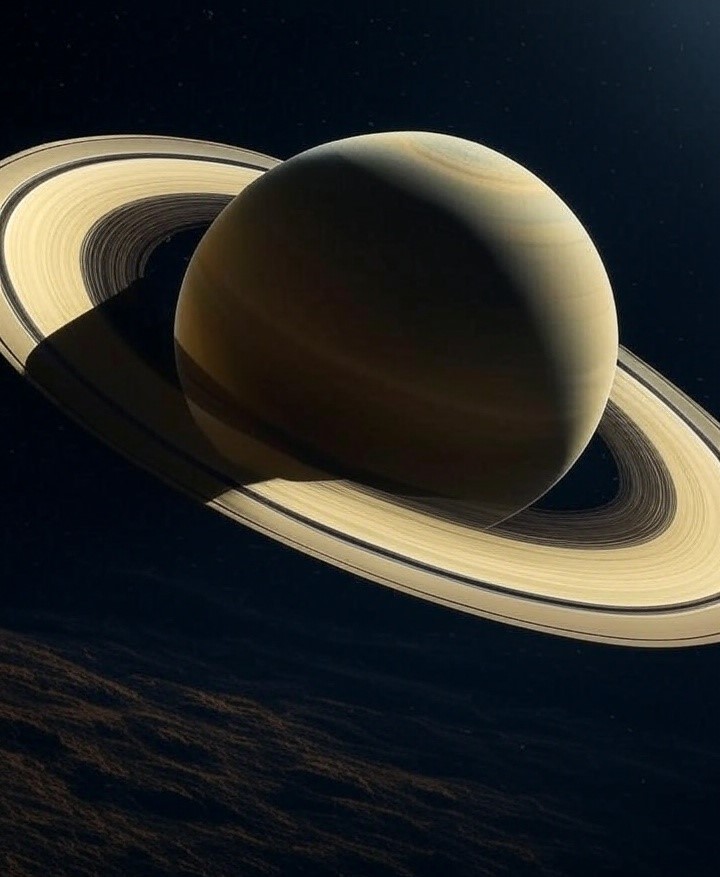
Here we are again, ready to explore another fascinating planet in our solar system! 🌠
We all know that most planets look like giant balls, but Saturn? Saturn stands out with its stunning rings! Ever wondered why? I always did. In fact, Saturn used to be my favorite planet just because it looked so different. But let’s skip the boring intro and dive straight into the exciting facts! 🚀
🪐 Saturn: The Gas Giant
Saturn is a gas giant primarily composed of helium and hydrogen, much like its big brother, Jupiter. It’s the second-largest planet in our solar system, after Jupiter. Just like Jupiter, Saturn also has a lot of moons — and I mean a lot! 🌙
146 moons have been confirmed so far (the highest number of moons any planet has), and there might be more waiting to be discovered. Among these, the most famous is Titan. You’ve probably seen Titan mentioned in sci-fi movies. 🎥
🌕 Titan: A Potentially Habitable Moon?
Titan is the second-largest moon in the solar system, after Jupiter’s Ganymede. Our Moon, which we simply call “The Moon,” is the fifth-largest moon. Although Saturn itself can’t support human life, Titan shows potential. Imagine a future where we say,
👉 “Our home is not Earth but the moon Titan.” Fascinating, right? 🌌
Titan has rivers, lakes, and seas — but not of water. They are filled with liquid methane and ethane. However, beneath its icy crust, there’s a subsurface ocean of liquid water mixed with ammonia, which is a key ingredient for life. NASA’s spacecraft Cassini provided evidence of this ocean, but nothing has been proven yet. 🌊
🌍 How Big Is Saturn?
Saturn is 755 times larger than Earth. 🌏 If you place Earth side by side, it would take 9 Earths to fill Saturn’s diameter.
🕒 One day on Saturn (the time it takes to complete one rotation on its axis) is around 10.7 Earth hours (though not yet confirmed). But here’s the fun part — a year on Saturn, or one complete orbit around the Sun, equals 29 Earth years! That’s a long wait for a birthday! 🎉
💫 The Mystery of Saturn’s Rings
Now, let’s talk about those breathtaking rings! Saturn doesn’t just have a ring — it has seven rings! These rings are separated by gaps known as the Cassini Division (named after Italian astronomer Giovanni Domenico Cassini, who first observed the divisions).
But what are these rings made of? Are they flat planets? Nope! Saturn’s rings are a dazzling collection of asteroids, comets, and shattered moons that were torn apart before they could reach the planet. So, what we see in the pictures is not the whole truth. 📸
📚 Did Saturn Always Have Rings?
Surprisingly, no! Saturn’s rings were formed around 100 million years ago, long after the planet itself, which formed 4.5 billion years ago. So yes, Saturn probably looked like a “normal” planet once. 🕰️
🔤 Naming the Rings: Easy to Remember!
Saturn’s rings are named A, B, C, D, E, F, and G, making them easy to remember. Of these,
- A, B, and C are the main rings, while
- D, E, F, and G are the fainter, less visible ones. 🌠
⏳ Saturn in Mythology
In Roman mythology, Saturn is the god of time and agriculture. Mythologies from Roman, Greek, and Egyptian cultures play a significant role in naming celestial bodies and shaping stories about the cosmos. If you’re interested, I can dive deeper into mythology related to space in future posts. Let me know! 🕊️
🧐 What’s Next?
We’ve been exploring the solar system for the last four posts. I think it’s time to wrap up with one last post — and it’s about a mystery planet. Can you guess which one? 🤔 If not, stay tuned for the next post!
⚡️ If this topic didn’t excite you, let me know. I’m here to explore whatever fascinates you!
Until then, that’s it for today!
Bye! 👋
Leave a Reply