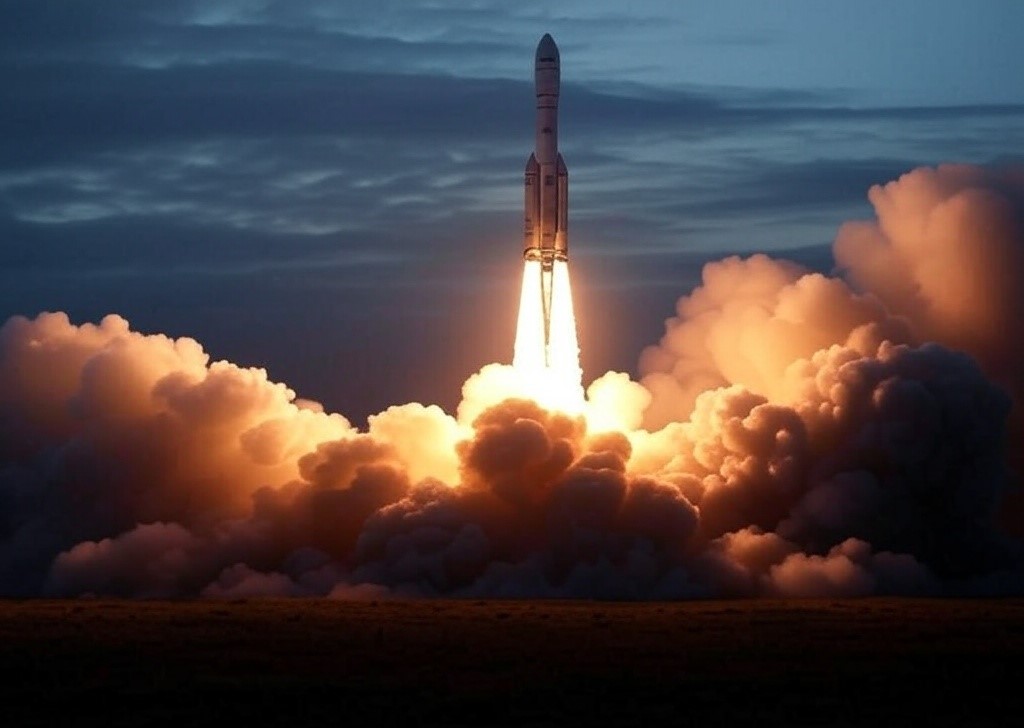
Shzzzzzzzz….
Yeah, that’s how rockets work. But what’s behind that shzzzzzz? 🤔
Come on, let’s take a closer look.
Before we dive in, let’s get the basics straight. Rockets are used in fireworks 🎆, missiles 💣, satellite launches 🛰️, human space travel 👩🚀, space exploration 🌌, and more. But for today, we’re focusing on one key mission:
➡️ Getting a spacecraft from Earth’s surface to outer space.
👨🔬 Built on Newton’s Three Laws of Motion
Don’t worry, this isn’t a boring physics class—well, maybe a little. But I promise, it’s going to be interesting. 😉
⚖️ Newton’s First Law:
An object at rest stays at rest, and an object in motion stays in motion unless acted upon by an external force.
If a rocket is launched upward, it will keep going—until gravity 🧲 tries to pull it back down. To stay in orbit, the rocket must escape Earth’s gravitational pull.
💪 Newton’s Second Law:
Force = Mass × Acceleration (F = ma)
To escape gravity, we need force—and that force depends on the mass of the rocket and how quickly it accelerates.
💡 Heavier rocket? You’ll need more force (thrust) to lift it.
That’s why rockets are built in stages—empty fuel tanks are dropped off to shed weight mid-flight. 🛠️
🔁 Newton’s Third Law:
For every action, there is an equal and opposite reaction.
Hot gases are blasted downward 🔥 through the rocket’s nozzles, and the rocket moves upward in response. That’s how the magic happens.
🧩 Anatomy of a Rocket
Let’s break it down. A typical rocket has four major systems:
🛰️ 1. Payload
What the rocket is carrying—this depends on the mission.
Example: A satellite? Then the satellite sits in the payload section.
🏗️ 2. Structure
Made of strong but lightweight materials like aluminum or titanium.
Keeps everything intact during the extreme forces of launch.
🧭 3. Guidance
Includes sensors, gyroscopes, radars, and communication systems that control the rocket’s direction and stability.
🔋 4. Propulsion
This is where the real action is: fuel, oxidizer, pumps, combustion chamber, and the nozzle that directs the exhaust gases.
🔥 How Does a Rocket Work?
Let’s get practical.
Think of launching a rocket like burning garbage (weird, but it works!). To burn the trash, you need:
- Fuel (the garbage) 🗑️
- Ignitor (a lighter) 🔥
- Oxygen (to keep it burning) 🧪
Now, if you put a glass over a candle 🕯️, it goes out, right? That’s because it runs out of oxygen.
In the same way, a rocket needs oxygen to keep burning—but there’s no oxygen in space!
So rockets carry their own oxygen source, or more broadly, an oxidizer—any chemical that helps combustion. 🧫
Once the fuel and oxidizer combine in the combustion chamber and are ignited, hot gases expand rapidly and blast through the nozzle.
⬇️ This downward blast = ⬆️ upward movement (thanks Newton!).
🧪 Types of Rocket Propulsion
Let’s look at the two major types of rockets based on the type of propellant used:
1️⃣ Solid-Propellant Rockets
These rockets have pre-mixed fuel and oxidizer, packed together into a solid material called a grain.
- 🔹 Grain: Solidified mix of fuel and oxidizer, shaped to control burn rate.
- 🔹 Casing: Metal shell (often insulated) to contain pressure.
- 🔹 Ignitor: A small explosive or spark starts the combustion.
Once lit, it burns continuously until all the propellant is used. No turning back! 🔥
Typical Ingredients:
- Fuel: Powdered aluminum
- Oxidizer: Ammonium perchlorate or ammonium nitrate
2️⃣ Liquid-Propellant Rockets
These are more complex, but more flexible.
- Fuel and oxidizer are stored separately
- Pumped into the combustion chamber via powerful turbopumps
- Mixed and ignited inside the chamber using sparks, catalysts, or even hypergolic reactions (ignite on contact)
This design allows precise control:
- You can throttle, shut down, and restart the engine!
Typical Ingredients:
- Fuel: RP-1 (refined kerosene), liquid hydrogen (LH₂), or hydrazine
- Oxidizer: Liquid oxygen (LOX), nitrogen tetroxide (N₂O₄)
🆚 Solid vs. Liquid Rockets – What’s the Difference?
| Feature | Solid-Propellant 🚀 | Liquid-Propellant 🚀 |
|---|---|---|
| Fuel/Oxidizer | Pre-mixed solid grain | Stored separately (liquid) |
| Ignition | One-time, no turning back | Can be restarted, throttled |
| Complexity | Simple, reliable | Complex, controllable |
| Flexibility | Low | High |
| Common Use | Boosters, missiles | Main engines, deep space |
🎯 Final Thoughts
So, the next time you hear that mighty “shzzzzzz”…
Just remember—it’s a beautifully engineered chain reaction of physics, chemistry, and precision mechanics at work. 💥
From Newton’s laws to nozzle dynamics, we’ve come a long way from the fireworks of ancient China to reusable rockets today.
That’s it for today, folks!
Hope you learned something cool and had fun doing it. 😄
Until next time—keep reaching for the stars! 🌠
Leave a Reply