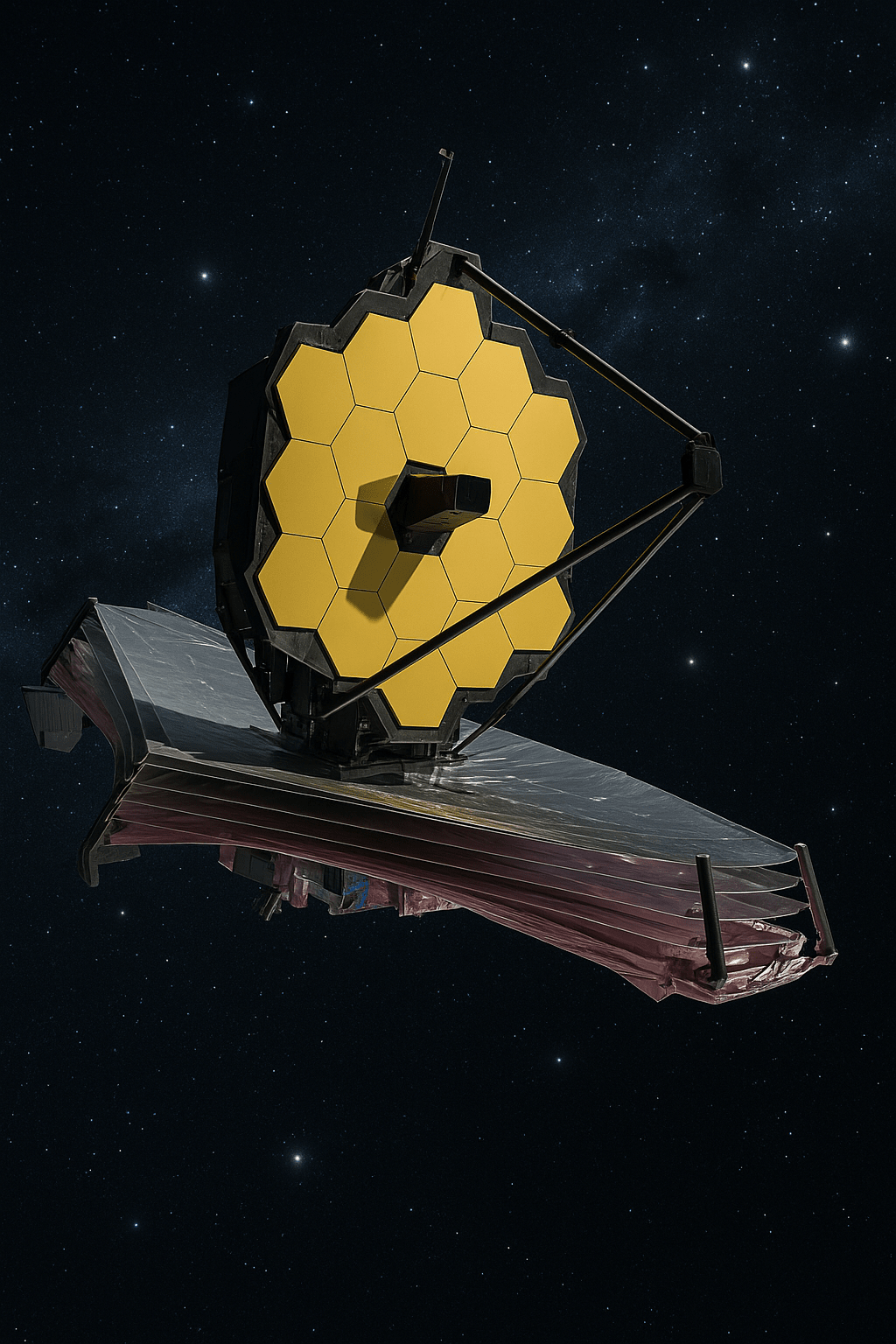
Since we’ve already explored the Hubble Space Telescope, it’s time to turn our eyes toward its magnificent successor — the James Webb Space Telescope (JWST). As curious explorers of the cosmos, it’s our responsibility to learn about this extraordinary tool that is redefining astronomy. So, without any further delay, let’s dive into yet another marvel in an astronomer’s toolkit! 🔭
🌠 From Hubble to Webb: The Evolution of a Vision
Back when NASA scientists were brainstorming the next step after Hubble, one key question sparked the idea: “What can’t Hubble do?” The answer — detect mid-infrared light — led to the birth of a new mission. Originally named the Next Generation Space Telescope, it was later renamed in honor of NASA Administrator James E. Webb, who played a pivotal role in the Apollo missions.
🚀 James Webb is the largest space telescope ever launched, with a stunning 6.6-meter primary mirror. It’s often dubbed a “time machine” because it captures light from galaxies billions of years in the past, helping us look back into the universe’s early history. It launched on December 25, 2021 — a true cosmic gift! 🎁🌌
🎯 JWST’s Key Objectives:
- Unravel the origin and evolution of the universe
- Study the early universe, galaxies, and star formation
- Observe exoplanets and search for potential signs of life 🌍🛸
🌟 Fascinating Discoveries by JWST
🪨 Asteroid 2024 YR4
In 2024, an asteroid — 2024 YR4 — raised concerns due to a slight chance of impact with Earth by 2032. Fortunately, thanks to JWST’s observations, NASA confirmed that even that slight chance is now nearly zero. Crisis averted! 🛡️
Webb also found that the asteroid is approximately building-sized — not a global threat, but definitely worth keeping an eye on!
🧊 Trans-Neptunian Objects (TNOs)
TNOs are small celestial bodies that orbit the Sun beyond Neptune. Webb revealed that these distant objects are extremely cold, as expected. More intriguingly, they may contain ices of molecules that are gaseous or liquid on Earth — giving us a peek into the chemistry of the outer solar system ❄️🧪
🌌 JADES-GS-z14-0: The Most Distant Galaxy
Webb detected a record-breaking galaxy named JADES-GS-z14-0, which spans over 1,600 light-years across. Located at a redshift of 13.2, it’s one of the most distant galaxies ever observed.
Even more exciting — Webb found hydrogen and oxygen in this galaxy, implying that massive stars once lived and exploded there. A cosmic revelation! 💥🌟
🌍 Methane on an Exoplanet
JWST studied the exoplanet WASP-80b, a “warm Jupiter” with a temperature of 825 K. During its transit across its host star, Webb detected water vapor — something previously seen in other exoplanets — and a rare trace of methane.
Finding methane is a big deal 🧬 because it could indicate interesting chemical processes, possibly even precursors to life. This discovery adds another piece to the cosmic puzzle 🧩
🌈 The Death of a Star
When stars like our Sun die, they become planetary nebulae. Webb offered a stunning view of such a nebula, revealing a bright ring composed of 20,000 dense clumps of molecular hydrogen gas, each roughly as massive as Earth.
Inside the ring lies a narrow emission band, while spikes radiate outward — all pointing back to the dying star at the center. A hauntingly beautiful farewell 💫🌠
🧭 Wrapping Up
While these are just a few of the many breathtaking discoveries, the James Webb Space Telescope is far from done. Its mission is ongoing, and every new image it sends deepens our understanding of the cosmos.
To explore more of JWST’s incredible findings, check out:
🔗 NASA’s Official JWST Page
🔗 ESA Webb Science
Leave a Reply