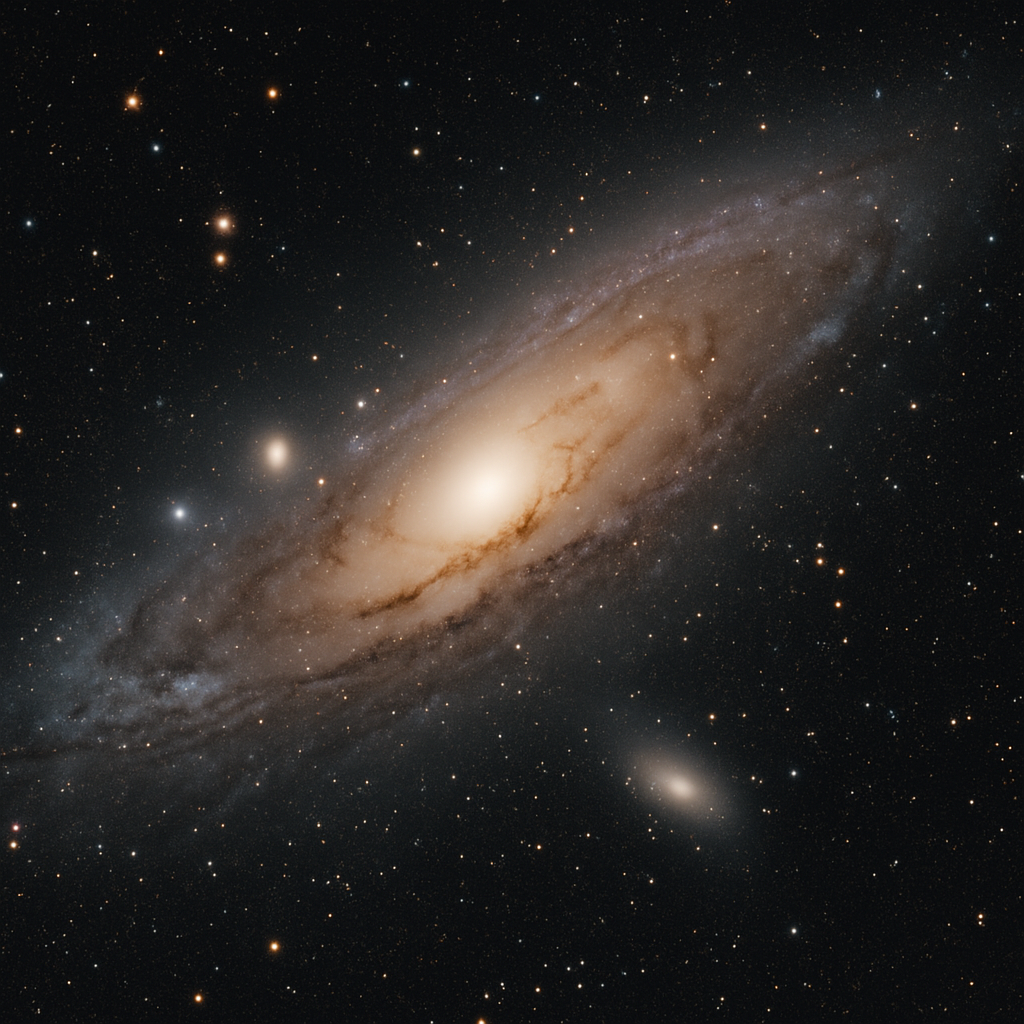
Welcome back, explorers! 🚀 Wishing you all a warm and beautiful day. 🌞 With that, let’s dive into yet another fascinating cosmic entity.
Have you ever wondered: Are we alone in this universe? 🤔
Is there another galaxy like ours? 🌠
Well, today, I’m going to answer one of those questions!
✅ Yes, there are countless galaxies in our universe!
And today, we’re going to learn about our nearest neighbor.
Nearest meaning within a 10 km radius? 🛵
No! It’s just 2.5 million light-years away from the Milky Way! 😄 Mind-blowing, right?
🌌 A Name with a Story: Andromeda 🌟
The Andromeda Galaxy was named after the Andromeda constellation, because, from our Earth-based perspective, it appears within its boundaries. (If you’re unfamiliar with constellations, feel free to check out images on Google 🌐 — but don’t worry, we’ll soon explore constellations in depth too! ✨)
The constellation itself was named after Princess Andromeda from Greek mythology, who was saved by the hero Perseus 🛡️ before being sacrificed to a sea monster.
(We’ll skip the mythology lesson today — let’s stay focused on the cosmos! 🚀)
📜 Another Name: Messier 31 (M31)
Our galactic neighbor also goes by the name Messier 31, or M31.
Where did that come from? Let’s dive into a bit of astronomical history. 🧑🚀
In the 1770s, a comet-hunting astronomer named Charles Messier grew frustrated. Why? Because many objects he detected weren’t comets — they were stars, nebulae, or galaxies!
So, he published a catalog listing these “non-comet” objects to help other astronomers avoid confusion. 📚✨
This catalog eventually grew to 110 objects, and guess what?
Andromeda was listed as the 31st — hence the name Messier 31 (M31).
Whoa, right? 😯 Just the name alone carries centuries of history!
🌟 Andromeda’s Incredible Features
Let’s explore what makes Andromeda so spectacular:
🔭 It is about 220,000 light-years across — making it larger than our Milky Way!
🌌 Both the Milky Way and Andromeda are spiral galaxies, but Andromeda has a bar-shaped structure at its center, slightly different from ours.
👀 You can see Andromeda with the naked eye, especially on a clear autumn night! 🍁
🌟 It’s estimated to contain over a trillion stars — imagine that!
🛰️ Dwarf Galaxies Around Andromeda
Andromeda isn’t alone! It’s surrounded by smaller companions like M32 and M110. 🛰️
You might wonder: “Dwarf galaxies? Why not full-fledged galaxies?“
Well, dwarf galaxies are less luminous and contain only a few billion stars.
They often orbit larger galaxies like the Milky Way and Andromeda — and because they emit less light, they’re harder to detect. 🔎
🌌 The Big Shift: Discovering Other Galaxies
In the early days of astronomy, people believed the Milky Way was the entire universe. 🌍
That belief changed forever when Edwin Hubble discovered that the Andromeda “nebula” was actually a separate galaxy.
🌟 That was a turning point — one that expanded humanity’s view of the cosmos forever!
🛰️ Hubble Space Telescope and Andromeda
Today, the Hubble Space Telescope continues to observe Andromeda, revealing its stunning secrets. 📸✨
- Hubble can detect only stars brighter than our Sun, yet it has identified over 200 million stars in Andromeda! 😲
- Hubble has also captured breathtaking images, showing Andromeda’s structure, stars, and dwarf galaxies.
- These observations have helped scientists understand Andromeda’s evolution, including its history of mergers with smaller galaxies.
🔮 A Peek into the Future: Collision Course
Fast-forward about 4 billion years into the future…
Andromeda and the Milky Way are expected to collide and merge into a giant elliptical galaxy! 🌌💥
Imagine witnessing two galaxies becoming one… wouldn’t that be magnificent? ✨
(Well, if we could somehow be alive then! 😄)
What do you think?
🌍 Will the world be ultra-futuristic by then — all AI, spaceports, and intergalactic travel? 🚀
Or could civilization cycle back into a new kind of “old age”? 🔥🏰
Let me know your thoughts! 🧠💬
🚀 That’s it for today, explorers! 🚀
I hope you enjoyed this journey through space and learned something new!
Bidding you farewell for now… but stay tuned for more mind-blowing cosmic facts, myths, and mysteries! 🌌✨
Until next time… keep exploring! 🚀💫
Leave a Reply