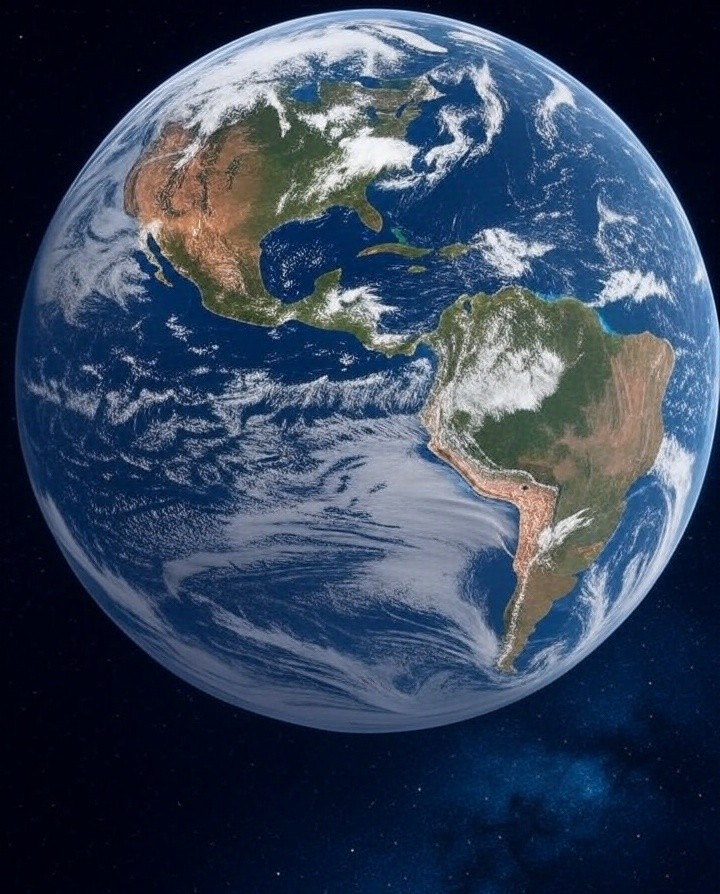
So, we’ve traveled in thought to Mars, exoplanets, black holes, galaxies, and the vast universe — and here we are, back to the place it all started: Earth.
Yes, we’re living on this beautiful planet. But here’s the thing — there’s so much we see every day that we don’t fully understand. This post is not about the unknown, it’s about what we already know — the everyday wonders around us. Scientists gave them names, reasons, and explanations. The real question is: do we know how these things actually happen? Let’s find out.
⚡ Read carefully — some explanations are built on others, so you won’t get confused if you follow along.
🌐 Earth’s Four Layers
Think of Earth as a giant ball:
- Crust → The surface we walk on. It’s the thinnest layer, less than 1% of Earth’s total mass. This is our home.
- Mantle → Beneath the crust, making up about 82% of Earth’s volume. It’s solid rock, but movement here drives the shifting of tectonic plates, causing earthquakes and volcanic activity.
- Outer Core → A super-hot, liquid layer of iron and nickel. This moving metal generates Earth’s magnetic field.
- Inner Core → A solid ball of iron. Even though it’s as hot as the Sun’s surface, the immense pressure keeps it from melting.
🌍 What Are Tectonic Plates?
Earth isn’t one solid, unbroken ball. The crust is broken into large slabs of rock called tectonic plates.
🪨 Imagine crushing an eggshell and then sticking the pieces back around the egg. That’s how tectonic plates cover Earth’s surface. These plates are constantly shifting — slowly but powerfully — shaping our planet’s surface.
🌎 The Four Spheres of Earth
Besides the layers, Earth is also studied in “spheres”:
- Atmosphere → The blanket of gases around Earth, made of 78% nitrogen and 21% oxygen.
- Hydrosphere → All the water: oceans (which cover 71% of Earth’s surface), rivers, lakes, glaciers, groundwater.
- Geosphere → The solid Earth, from crust to core. (Here’s where the lithosphere fits in — the crust + upper mantle. That’s what tectonic plates are made of.)
- Biosphere → All living organisms and their ecosystems — including us.
☁️ Layers of the Atmosphere
The atmosphere itself is divided into five layers:
- Troposphere → From the surface up to ~12 km (7.5 miles). Holds most gases, weather, clouds, and breathable air.
- Stratosphere → Up to ~50 km. Home of the ozone layer (shields us from harmful UV radiation). Jet planes cruise here to avoid turbulence. ✈️
- Mesosphere → 50–80 km. The coldest layer, where meteors burn up as shooting stars. ☄️
- Thermosphere → 80–700 km. The stage for auroras 🌌 and where the ISS orbits Earth.
- Exosphere → 700–10,000 km. The fading edge into space, filled with hydrogen and helium. Most satellites orbit here. 🛰️
🌟 Quick Earth Facts
- 🌍 Orbit around Sun → 365.25 days
- 🌙 Moon → Earth’s only natural satellite
- ⏳ One rotation → 23 hours 56 minutes
- 📏 Diameter → 12,756 km
- ☀️ Sunlight travel time → 8 minutes 20 seconds
- 🌞 Earth–Sun distance → 149.6 million km (93 million miles)
🚀 Wrapping Up
Earth is still the only known habitable planet in our solar system. The more we look closely, the more we realize there’s wonder everywhere — not just in distant galaxies, but right under our feet.
If this is your first post on Nova Klyne Chronicles, I highly suggest checking out the others. Pick a topic that excites you, and dive in.
See you soon, champ! ✨
Leave a Reply