Woah! What a wonderful day! 🌞
Okay, actually… it was a pretty bad day. Like really bad. 😞
But you know what? I decided to write a blog post—and boom! 💥—my spirits lifted the moment I started reading about neutron stars. These mysterious beasts of the cosmos have an energy that’s absolutely contagious. 💫
Wait, wait! You might be thinking,
“Didn’t you already write about this in Understanding Supernovae?”
You’re right! But this time, we’re not just brushing the surface—we’re going deeper. We’re about to unravel the core mysteries of these stellar remnants. Ready to dive into the cosmos? Let’s go! 🚀✨
🧲 What Are Neutron Stars?
Just like the name suggests, neutron stars are made up mostly of neutrons. 🧬
If you haven’t read my post on the death of stars, here’s the Understanding Supernova 🔗—it’s important context for this journey.
After a massive star collapses in a supernova, the protons and electrons inside its core are crushed together, forming neutrons. What’s left behind is a neutron star—a tiny, ultra-dense core that packs a punch! 💥🌠
⚡ Quick Recap Time!
- 🌀 Densest matter in the universe (not counting black holes)
- 🏙️ A giant star squeezed into the size of a city
- ⚖️ 1 teaspoon of neutron-star material weighs about 1 trillion kilograms
- 🌀 Rotates faster than a blender
- 🤯 Mind. Blown.
🌟 The Lighthouses of the Cosmos
Neutron stars can act like cosmic lighthouses. Why?
Because certain types—called pulsars—emit focused beams of light and radiation. 🌠
As they spin, these beams sweep across space. If Earth is in their path, we detect flashes—just like a lighthouse!
While a lighthouse completes one rotation in ~40 seconds, pulsars can rotate up to 43,000 times per minute. 😱
That’s so fast, we might not even perceive the flash—it would just appear as a constant glow. What do you think? 🤔
📻 A Flashback to 1967
Let’s time travel ⏳ to 1967, when something strange happened.
Astronomers picked up regular radio pulses from space. They were so consistent that people thought:
“Could this be an alien signal?” 👽📡
Then came the moment of clarity:
Jocelyn Bell Burnell, a brilliant student, and her mentor discovered that it was not aliens—but the first pulsar: PSR B1919+21. 🔭
These were the signs of a rapidly spinning neutron star!
🧲 Magnetic Monsters
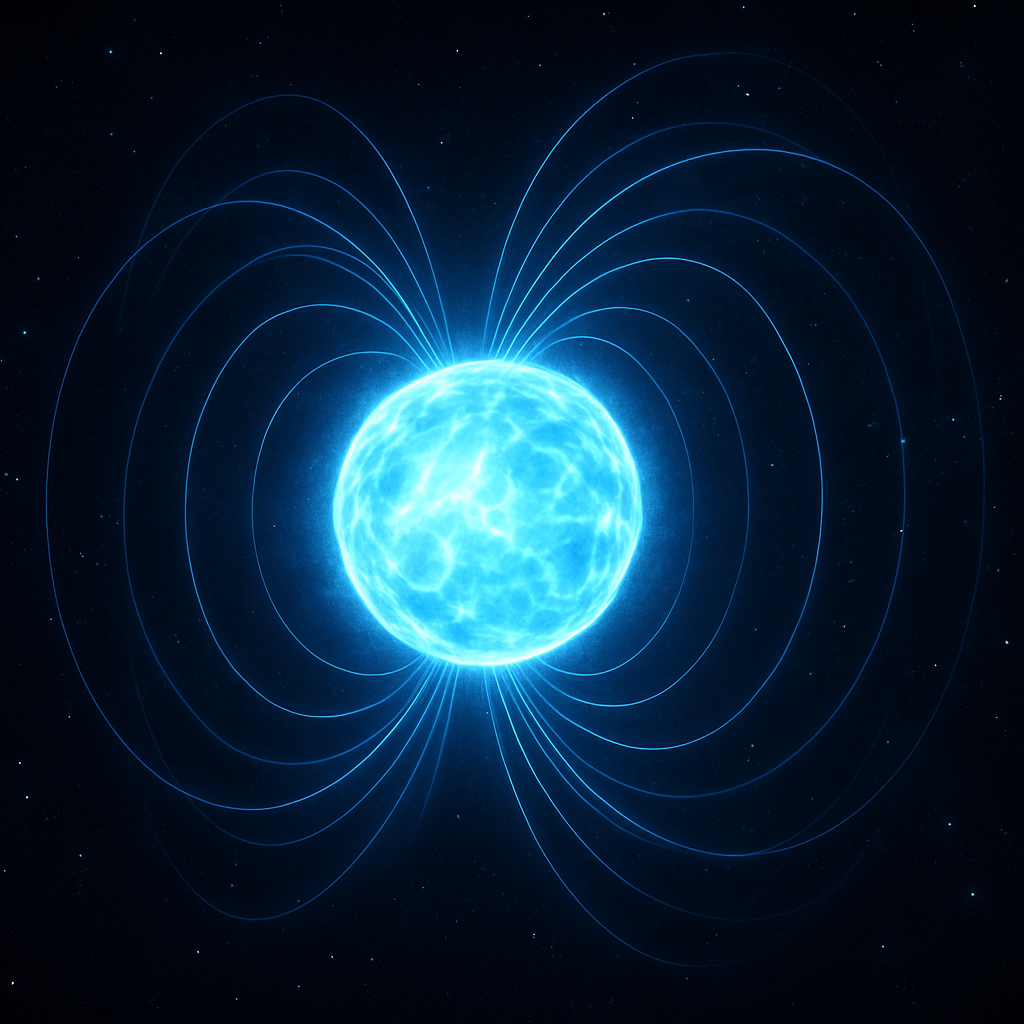
Neutron stars have magnetic fields that are billions of times stronger than Earth’s.
And some, called magnetars, are even wilder—their magnetic fields are up to a thousand times stronger than other neutron stars! 🧲⚡
Though mostly made of neutrons, their inner cores remain a mystery. Scientists believe they may contain exotic matter—something we’ve never seen before. 🤯🧪
🧠 Let’s Get Sci-Fi for a Second…
Imagine standing on the surface of a neutron star (okay, theoretically 😅).
Let’s say you’re wearing the most advanced high-tech suit in the universe. What happens?
- ❌ You can’t move.
- 🧍 You can’t lift even your own hand.
- 🪨 You weigh billions of times more than on Earth.
- 🏃 To escape? You’d need to move at 120,000 km/s.
- ☠️ Even light struggles to escape that gravity.
That’s how powerful neutron stars are. They bend space, time, and logic.
🌌 Do They Wander?
Yes, neutron stars wander through the galaxy. They’re not fixed like our Sun.
They can:
- Orbit other stars or black holes 🌀
- Drift solo through interstellar space 🌠
- Be launched at crazy speeds by supernova kicks (up to 1,500 km/s!) 🚀
💥 Can They Collide?
Absolutely. Though space is vast, sometimes these stellar bullets do collide:
- 💥 Neutron star + Neutron star = Kilonova → Huge explosion → Possible black hole
- 🕳️ Neutron star + Black hole = The star gets swallowed 😶🌫️
- 🪐 Collide with a planet? Extremely rare—but theoretically possible!
Good news? ✅
We’re in a quiet neighborhood of the Milky Way, far from danger.
But the Milky Way holds 100 million+ neutron stars, so who knows what could happen billions of years from now? 😳
📝 Final Thoughts
From being mistaken as alien signals to bending space and time, neutron stars are one of the most extreme and fascinating things in the universe. They remind us that even after destruction (a star’s death), something powerful and mysterious can still rise. ✨
That’s all for now, stargazers! 🌌
Let me know in the comments: Would you rather visit a black hole or a neutron star (with a suit, of course)? 👩🚀
Until next time,
Stay curious. Stay cosmic. 💫
Leave a Reply